If you have already done the Mara and want western Kenya on your next trip, this Saiwa Swamp National Park sitatunga guide gives you an honest introduction. It is Kenya’s smallest national park, covering roughly 2 square kilometers of papyrus swamp near Kitale. There are no game drives here. No vehicles are allowed inside at all. You walk, on raised boardwalks and wooden tree-top platforms, to look for one animal in particular: the sitatunga.
This is not a full-day park. Budget two to three hours. What makes it worth the detour is the sitatunga itself, an antelope so shy and water-adapted that most visitors to Kenya never see one anywhere else.
Saiwa Swamp National Park sitatunga guide: what makes it special
Saiwa Swamp was gazetted in 1974 for one reason: to protect a breeding population of sitatunga antelope in a swamp habitat that was shrinking elsewhere in western Kenya. It remains one of the only places in the country where you can reliably see this species in the wild.
The park has no roads for tourist vehicles. Instead, KWS built wooden boardwalks through the papyrus and three tree-top viewing towers, some over 10 meters high. You climb them quietly and wait. That waiting is the whole experience, and it rewards patience more than speed.
Where is Saiwa Swamp National Park located
Saiwa Swamp sits in Trans Nzoia County, about 20 kilometers north of Kitale town, on the road toward Kapenguria. From Nairobi, it is roughly 420 kilometers, a drive of 7 to 8 hours on the A104 through Nakuru and Eldoret.
The final stretch matters more than the total distance. Turn off at Kipsaina junction and you have about 5 kilometers of unpaved murram road left to the gate. It is manageable in a saloon car in dry weather, but a 4×4 is the safer call after rain, when the surface turns slick and rutted.
The sitatunga: what makes it different from other antelope
The sitatunga is built for swamp life in a way most antelope are not. Its hooves are long and splayed, spreading its weight so it can walk on floating vegetation and soft mud without sinking. It swims well and will submerge itself, leaving only its nostrils above water, to hide from predators.
Males are dark brown to grey with a shaggy coat and spiral horns up to 90 centimeters long. Females are smaller and more reddish. Both are naturally reclusive, feeding mainly at dawn, dusk, and through the night, which is why timing your visit matters more here than at almost any other Kenyan park.
Best time to see sitatunga at Saiwa Swamp
Early morning, between 6:30 and 9:00 am, gives you the best odds. Sitatunga feed actively then before retreating deeper into the papyrus as the day warms. Late afternoon, from around 4:00 pm to closing, is the second-best window.
Seasonally, the dry months of January to February and June to September are easier for viewing, since lower water levels concentrate the antelope in fewer channels. During the long rains from March to May, the swamp floods further and sightings get harder, though birdlife stays strong year-round.
Even with good timing, treat a sighting as likely, not guaranteed. Guides at the gate know the current feeding spots and are worth the small tip for their local knowledge.
Other wildlife and birdlife
Sitatunga draw the visitors, but Saiwa Swamp holds more. De Brazza’s monkey, a bearded, orange-browed primate rare elsewhere in Kenya, lives in the forest fringing the swamp. Spotted-necked otters fish the channels, and serval cats pass through, though both are seen far less often than the primates or antelope.
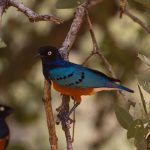
Birders have the strongest odds of a rewarding visit regardless of luck with mammals. Over 370 bird species have been recorded here, including the blue-headed bee-eater, Ross’s turaco, and various kingfishers working the swamp edges. If you plan to photograph any of this, especially the sitatunga at range, pair this stop with our notes on the best lens for photographing shy wildlife like the sitatunga.
Activities: what you actually do at Saiwa Swamp
There are no vehicles and no lodges inside the boundary, which keeps the pace slow. A typical visit follows this pattern:
- Walk the main boardwalk loop, about 3 kilometers round trip.
- Climb one or two of the three tree-top platforms and wait quietly for 15 to 20 minutes at each.
- Take the shorter forest trail for De Brazza’s monkey and birding.
- Exit through the gate area, where guides can point you toward recent sightings.
Bring binoculars. Distances across the swamp are often 40 to 80 meters, too far for a clear naked-eye view of a sitatunga half-submerged in reeds.
Park entrance fees
KWS has not published Saiwa Swamp fees at the same tier as the major parks, since it sits in a lower-traffic category. As an indicative range, expect non-resident adult entry in the USD 20 to 25 per day bracket, with lower rates for residents and children. Confirm current pricing directly with KWS or your operator before travel, since fee structures are reviewed periodically.
If you are combining this stop with a wider itinerary, it helps to understand camera permit fees at Kenya’s national parks as well, since larger camera setups sometimes carry a separate charge at KWS gates.
Where to stay
Options near Saiwa Swamp are limited and simple, which suits the park’s low-key character.
| Option | Location | Distance to Saiwa Swamp | Approx. price range |
|---|---|---|---|
| Tree Top Hut | Inside the park | 0 km | Budget, single unit, book direct with KWS |
| Sirikwa Hotel | Kitale town | ~20 km | USD 40-70/night |
| Kitale Museum campsite | Kitale town | ~20 km | USD 10-15/night camping |
| Mount Elgon lodges | Endebess area | ~35 km | USD 60-120/night |
The Tree Top Hut is the one accommodation inside the park itself, and it is a single unit. That means only one group can book it at a time, so reserve well ahead if you want to wake up inside the swamp rather than drive in for the morning session.
What else to do nearby
Saiwa Swamp rarely works as a standalone destination, and it is not meant to. Pair it with Kitale town for its museum and market, or push on to Mount Elgon National Park, about 35 kilometers away, for its caves and moorland. Kakamega Forest, Kenya’s last remnant of tropical rainforest, sits roughly 100 kilometers south and pairs well with an overnight.
For repeat visitors weighing this against Samburu or Laikipia on the same trip, it helps to think through how many nights to budget at each stop on your itinerary before locking the route. Saiwa Swamp earns a morning or afternoon, not a full day.
Is Saiwa Swamp National Park worth visiting
For a first-time Kenya visitor chasing the big five, probably not on its own. For a repeat visitor who has done the Mara and Amboseli and wants something different, yes. It offers a rare antelope, quiet walking trails, and a genuine break from vehicle-based viewing, all in one of the least visited corners of the KWS network.
Treat it as a two to three hour stop on a western Kenya loop, not a headline destination.
The SafariPure Difference
Most guides to Saiwa Swamp read like a list of facts lifted from a KWS brochure. We would rather tell you what the visit actually feels like: quiet boardwalks, long waits on tree platforms, and a real chance you leave without a clean sitatunga sighting if you skip the early morning slot.
We plan western Kenya routes the way we plan any safari, around timing, road conditions, and what a place can realistically deliver in the hours you give it. That means telling you plainly that Saiwa Swamp is a half-day stop best paired with Mount Elgon or Kakamega Forest, not oversold as a park that needs a full day on its own.
Plan your western Kenya route with SafariPure
If Saiwa Swamp fits your route between Samburu, Laikipia, and the Kaya forests, we can help you sequence it properly, from gate timing to where to sleep the night before. Reach out through our contact page and we will help you build an itinerary that actually matches the time you have.